agents§
I use one AI agent, Pi, in the terminal. Pi comes small on purpose: a model, a few tools and an editor, and the rest you add with packages. Most of what I add is my own now, pi-harness. The story of why is in the post about it.
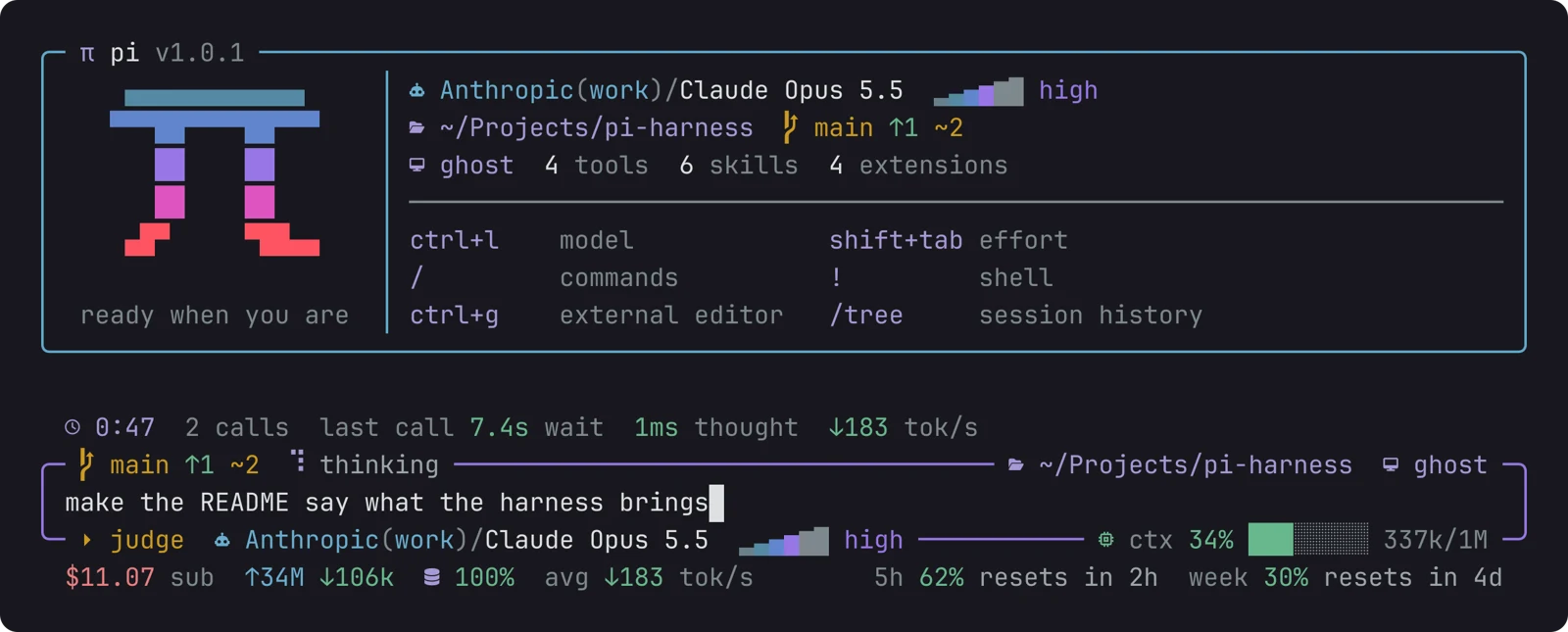
Pi when it starts, and a prompt halfway through its answer. The start card, the frame and the footer are my own harness, drawn by the look.
Install§
The script installs Pi with the npm of whatever Node is active, here Node 24 from fnm, and adds the # Pi line to my config.fish. Then /login anthropic connects my Claude subscription, and I stay on Claude Opus 5.5, medium effort.
Settings§
The ones I changed in ~/.pi/agent/settings.json:
| Setting | Why |
|---|---|
outputPad: 0 |
code blocks get the full width |
steeringMode: all |
messages I send while it works arrive together, not one per step |
followUpMode: all |
same for follow-ups (Alt+Enter) |
showCacheMissNotices |
tells me when a turn costs more because the cache missed |
enableInstallTelemetry: false |
no install reports |
warnings.anthropicExtraUsage: false |
providers bills the subscription, so the warning is wrong |
defaultModel: claude-opus-5-5 |
where every session starts |
Packages§
pi install npm:<name> writes each line for you.
"packages": [
  "npm:@adeildo/pi-harness",
  "npm:pi-hide-providers",
  "npm:pi-web-access",
  "npm:pi-memory",
  "npm:pi-subagents"
]
pi-harness§
I wrote this one. Four pieces on top of Pi, no fork. Alt+S opens the settings of all of them, and pi config turns any of them off.
permission§
Pi runs every tool call without asking. This makes it ask: yes, always yes or no, with a note the model reads. A no to npm install with “use pnpm instead” makes it switch to pnpm.
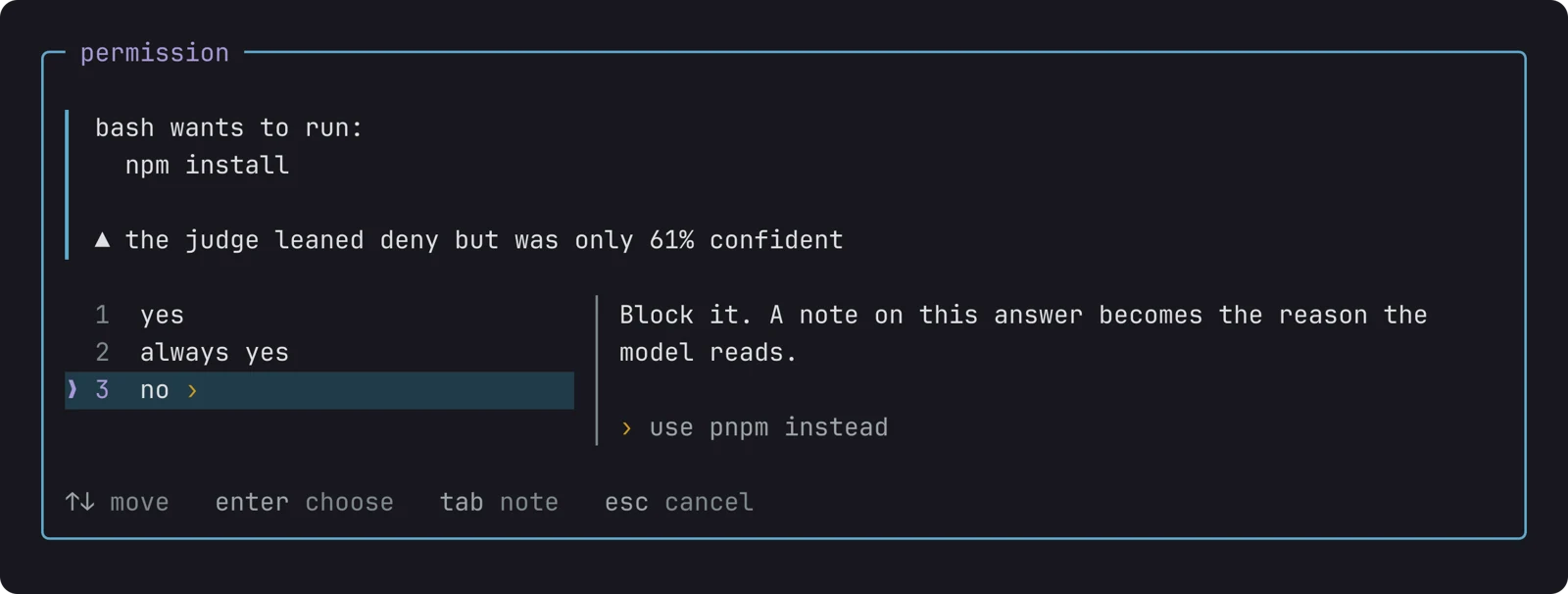
Reads never ask, and an edit shows its diff. Alt+M switches between manual, edits, judge and full. I live in judge: a small model, Jev from typesafe.ai, reads every call that isn’t a read or an edit, and I only see the ones it doubts. Each call says on its frame who let it through:
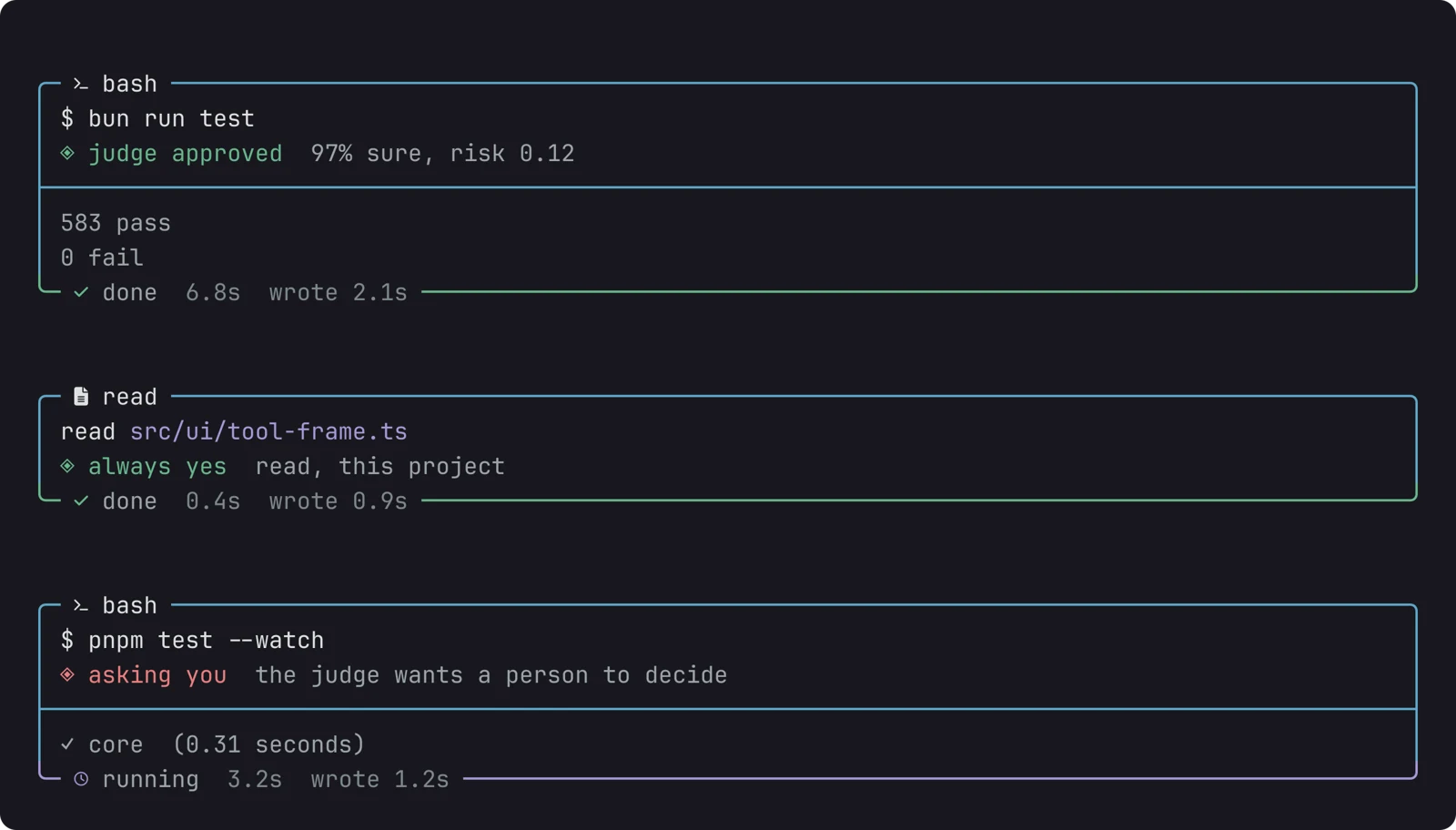
Mine runs on relaxed rigor (55% sure, risk up to 0.60) and gives up after 2 seconds, which sends the call to me. The policy is plain text:
# May run without asking
- Reading, searching, and listing files
- Editing files inside the project
- Running tests, linters, type checks, builds, and formatters
- git status, diff, log, add, and commit

# Must always ask first
- sudo, or anything that changes state outside the project
- Installing or upgrading global packages
- Pushing, force operations, or rewriting history
- Downloading and running remote scripts
- Deleting files outside the project, or recursive deletes

# When in doubt
Ask me.
Calls outside the project go to the judge like any other, since I work across repos a lot.
questions§
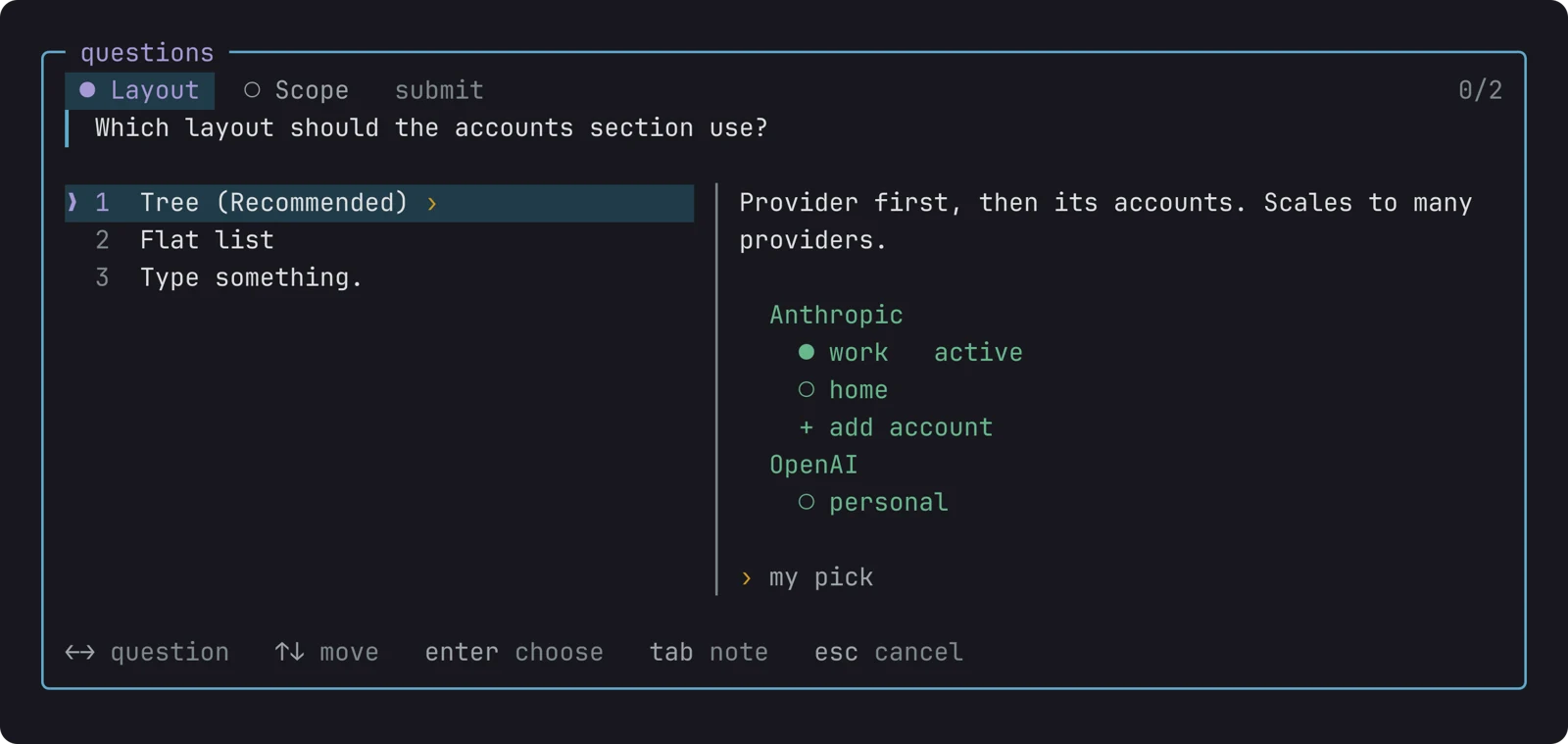
When something could go two ways, the agent asks instead of guessing: options, a preview of each, and a row for my own answer. Tab leaves a note on any option, picked or not. The permission dialog is this same dialog, with the same keys.
look§
Pi’s screen, drawn around what matters while the agent works: the start card, a frame around every tool call, a stopwatch above the editor, the branch, the mode and the model on the editor’s borders, and a footer with the cost and how much of the Claude plan is left. It replaced pi-open-tui, and nothing on it dances: every number has a fixed width.
providers§
Bills Pi’s Claude requests to my Pro/Max plan instead of extra usage, by introducing Pi to Anthropic as Claude Code. It also keeps two accounts, mine and the work one (ranqia). Alt+A switches between them, and when one hits a limit it offers to move to the other.
Read the fine print
Using your subscription from anything other than Claude Code may break Anthropic’s terms. Decide if that’s a risk you’re fine with. A request with an API key goes out untouched.
From other people§
| Package | What it does for me |
|---|---|
| pi-hide-providers | hides Amazon Bedrock from /model, which shows up because my shell exports a work AWS_PROFILE |
| pi-web-access | search, pages, GitHub repos, PDFs and YouTube, with no API key |
| pi-memory | decisions, a daily log and a scratchpad in markdown, searched by meaning with qmd. It’s why I never repeat “commits are one line” |
| pi-subagents | hands a task to a child session with a clean context and a cheaper model, only when I ask |
MCP needs no package anymore. Pi reads .pi/mcp.json in each trusted project since 0.99, and every MCP call goes through permission.
Skills§
Installed with skills: npx skills add <repo>.
| Skill | From | For |
|---|---|---|
unslop |
cursor/plugins | text that doesn’t sound like AI. This wiki went through it |
simplify |
brianlovin/agent-config | cleaning up code that was just written |
code-review |
mattpocock/skills | reviewing a branch against the repo’s standards and the issue |
frontend-design |
anthropics/skills | interfaces with a real visual direction |
web-design-guidelines |
vercel-labs/agent-skills | reviewing a UI for accessibility |
tui-design |
hyperb1iss/hyperskills | terminal interfaces. The look got a lot of it |
find-skills |
vercel-labs/skills | finding other skills |
What’s still missing§
Everything here assumes one session, one terminal, and me in front of it. Next on the roadmap:
- Sessions that talk, passing what one found to another.
- My phone, to follow a session and approve a call from anywhere, under the same policy, probably over Tailscale.
- My own memory and web access, so pi-memory and pi-web-access share state with the rest of the harness.